
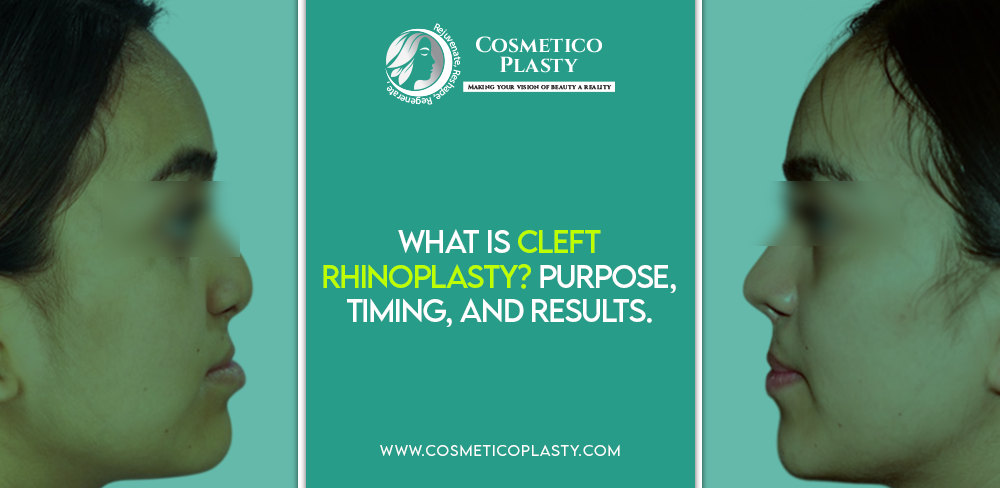
The shape of the nose can greatly influence facial features and confidence. At the same time, your nose is not just about appearance; it also affects breathing and overall comfort. In people who are born with a cleft lip or cleft palate, nose deformities are very common issues. Such differences can be impactful on nasal function, aesthetics, and thus life quality.
Cleft rhinoplasty surgery in Lahore is a reconstructive surgical procedure that is specifically used to correct the distinct nasal deformities that result in a cleft. In contrast to traditional rhinoplasty procedures that target aesthetic improvement alone, cleft rhinoplasty is both a functional and an aesthetically-oriented procedure that intends to achieve symmetry of the facial structure.

The improvements can meet your expectations if the surgeon performing the procedure is well-rounded. Prof. Dr. Mustehsan Bashir at Cosmeticoplasty is exceptionally good at performing rhinoplasty surgeries of all kinds. His clinical judgments, patient care and use of the latest technologies result in pleasant and natural outcomes.
This article explains what is cleft rhinoplasty, and gives a brief description about its purpose, timings and possible results.
A cleft lip is a congenital defect. It means it is a condition present at birth. It happens when a baby doesn’t develop properly in terms of their lip/mouth in the mother’s womb.
The word cleft means a split, which happens due to the tissue of the lip or roof of the mouth failing to completely join before birth. It leads to a small groove in the skin of a baby’s lip, which can also be large enough to reach into the nose. Therefore, nasal abnormalities are frequently present in children born with a cleft lip, a cleft palate, or both.
These happen because the cleft affects the nose’s underlying cartilage, bone, and soft tissues in addition to the lip or palate. Cleft patients often come with asymmetry of the nostrils, flattening or broadening of the nasal tip, distortion of the nasal septum, and collapse of the nasal airway on the cleft side.
Patients with bilateral cleft lip may have a wider nose with a less projecting nasal tip, while patients with unilateral cleft lip may have a flattened or displaced nose on one side.
Such complexities can bring both functional and aesthetic changes. The nasal obstruction, difficulty breathing through the nose, or nasal congestion are observable in these cases. Cleft rhinoplasty is the effective solution to such complex anatomical differences.
A special type of rhinoplasty surgery that aspires to correct nasal deformities for people with clefts is called cleft rhinoplasty. Performed as part of comprehensive cleft care, this procedure raises an important question for patients and families, Is rhinoplasty right for you? The surgery may involve nasal cartilage reshaping, nasal bone repositioning, correction of the nasal septum, and refinement of the nostrils and nasal tip. Once face growth is finished, the treatment can be performed as a definitive surgery or in phases over a number of years.
In contrast to conventional rhinoplasty surgery, cleft Rhinoplasty for Asymmetrical Nasal Anatomy must consider scar tissue from previous surgeries as well as the position and strength of the cartilage. Owing to the intricate and distinct techniques required for this surgery, the surgeons performing this surgery usually have training in the area of craniofacial or cleft surgery.
The main objectives of cleft rhinoplasty comprise;
One main reason to perform this procedure is breathing improvement through the nose. Many patients face problems in breathing because their nose is obstructed due to septal deviation and/or nasal valve collapse and/or unequal nostrils as a result of the cleft. The surgery can resolve all the issues and help patients to feel good physically as well as mentally.
Facial symmetry has been observed to play a significant role in a person’s sense of identity as well as in social interactions. Cleft rhinoplasty is a way to achieve a more balanced and natural nose shape in relation to the rest of the face features. Thus, surgeons enhance the nasal tip definition and the nostril alignment, as well as straightening a crooked nose.
For many patients, particularly adolescents and adults, nasal appearance is a matter of confidence and self-assurance. Smoothing out nasal imperfections can thus help with all these elements. Thus, it helps such patients to better interact socially and lead a quality life.
Receive Precise, Safe and Advanced Rhinoplasty From Prof. Dr Mustehsan Bashir
The time you choose to undergo the procedure is a critical part. The evaluation of the right time significantly depends on the patient’s age, growth rate and personalized rhinoplasty goals. It is often categorized into three stages.
Like any complex surgery, recovery after cleft rhinoplasty is a gradual process. It requires careful monitoring to ensure that both function and appearance are restored properly. Immediately postoperatively, patients should expect swelling, bruising, and mild discomfort of the nose and upper lip.
It reaches its peak during the first week, then subsides progressively. Surgeons may apply a nasal splint or dressing to support the new structure of the nose. At the same time, internal splints or sutures help to maintain alignment of the airway. A temporary congestion may occur in breathing, which improves as healing progresses.
Approximately 7-10 days remain enough to return to light activities. However, to secure the surgical outcomes it’s not good to engage in strenuous activity. “Follow-up visits are important to allow healing to proceed, manage scar maturation, and verify nasal balance and function. “On average, it may require up to a year for the results to settle in, especially in the more difficult cleft instances.”
The expected outcomes of cleft rhinoplasty are very positive. It aims at obtaining a more symmetrical nose, a stronger, supportive framework, a more efficient function of the nose, as well as an aesthetically appealing nose that complements the rest of the face. You can have a more symmetrical nose, tip definition, and correction of asymmetry following a rhinoplasty procedure.
In terms of functional enhancement, one can expect a better airflow passage as a result of a more supportive nose and a more aligned septum. However, in most cases, the silhouettes of scars are expected to fade as a person grows, while the nose’s supportive structure will also become stronger as a result of the healing process. In essence, cleft rhinoplasty provides long-term solutions in terms of both functionality and aesthetics of the nose.
In the closure, cleft rhinoplasty is an essential part of total cleft management. It helps in dealing with the functionality and cosmetic issues that result from cases of cleft lip and palate. It helps in improving the nasal structure and function, and subsequently, more importantly, the aesthetics.
Hence, it is an important part and pillar of improving the quality of life for such patients. Cleft rhinoplasty, with new advances and developments in technology, provides innovative results for such patients across all life periods.
Prof. Dr Mustehsan Bashir at Cosmeticoplasty believes that the use of modern tools meld with the expertise of a surgeon, can do wonders for patients. Therefore, patients under his care receive the newest, precise and safe procedures along with exceptional care. Approaching such a surgeon with considerable knowledge about the procedure is all you need to be confident, satisfied and healthier.
WhatsApp us