
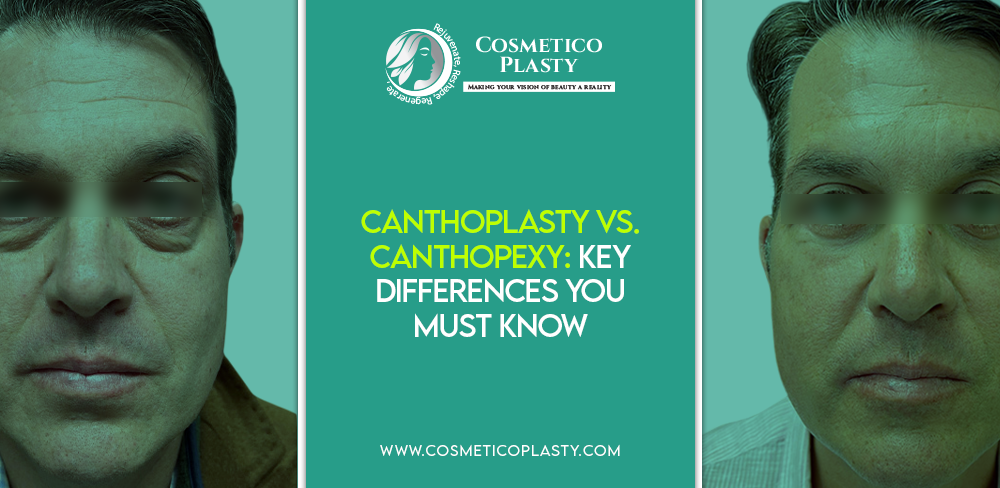
The eyes are one of the most expressive features of the face. Even small changes around the eyelids, such as drooping skin, puffiness, or under-eye bags- can become noticeably visible and may make you look tired, older, or less refreshed. It shows how important the eyelid area is, not only for appearance but also for overall facial harmony and confidence.
With modern advances in cosmetic and reconstructive surgery, many eyelid concerns can now be treated safely and effectively. Whether the issue is caused by aging, genetics, trauma, or complications from previous procedures, today’s techniques make it possible to restore a more refreshed, balanced, and natural look, while preserving your unique expressions.

Among the many procedures available, canthoplasty and canthopexy are two very commonly practiced. However, the majority often seem confused. Both of these target the corner area of the eye, referred to as the lateral canthus. Although the names also resemble each other, both of these surgeries are very distinct in their objectives, complexity, and success, ranging from simple support to complete reconstruction.
To help one understand and plan accordingly, it is very important to know and understand the basic contrasts between canthoplasty vs canthopexy. Aside from the information you get from other sources, a dedicated professional like Prof. Dr. Mustehsan Bashir of Cosmeticoplasty can help resolve the issue. He is highly appreciated for his skills in more specialized eyelid surgeries, with customized treatments in place to focus on natural looks, eye function, and complete success in surgery.
The article is going to mention all the differences between the two procedures to let you feel confident about your decision about picking one.
Visit Cosmeticoplasty for Eyelid Surgery From Dr Mustehsan Bashir
It is important to familiarize yourself with the anatomy of your body before you attempt to understand any kind of procedure. So it is viable for your eyes. The lateral canthus is the area where the upper and lower lids meet. It is fixed by the lateral canthal tendon, whose function is to offer stability and support to the lids. Though it might seem small, its role in the function as well as the aesthetics of the eye is extremely important.
Over time, under the influence of genes, trauma, or previous surgeries, the lateral canthal tendon can displace or get loose. Consequently, it can impair the eye corner by making it droop, swell, and become red and irritated. It causes associated epiphora and makes the eyes look tired.
Both canthopexy and canthoplasty correct problems with the loose lateral canthal tendon. However, each procedure addresses the issue in its own way. First offers subtle support, and the second comes with long-term reconstructive alterations.
Canthoplasty and canthopexy are high-impact procedures aspiring improvements in function and aesthetics of eyelids. From the scientific standpoint, they both correct the lateral canthus. Yet they differ greatly in terms of their purposes, surgical techniques, and levels of invasiveness. In order to determine the best option, being knowledgeable about these differences perfectly works. Here are some;
Patients who exhibit moderate to severe eyelid laxity, malposition, or underlying structural weakness of the lower eyelid are typically candidates for canthoplasty. Conditions include ectropion (in which the lower eyelid rolls outward), apparent eyelid sagging, rounding of the outer eye corner, or aging-related instability are common indicators.
Additionally, it is often advised for patients whose eyelid support has been weakened by trauma, tumor excision, or prior eyelid surgery. The procedure serves as both a reconstructive and cosmetic operation because it includes cutting and repairing the lateral canthal tendon. This allows for extensive redesigning of the eye’s contour, location, and tilt while providing strong, long-lasting support.
Canthopexy, on the other hand, is usually good for patients with mild laxity in the eyelid. Moreover, those who have the tendency to develop ptosis of the eyelid but do not need a complete reconstructive operation can consider it. The best part is that it can support the postoperative positioning of the eyelid and avert postoperative complications.
Canthopexy preserves the normal structure of the eye rather than completely changing it. This method improves eyelid support without requiring significant structural correction and offers minor stabilization and improvement.
The procedures differ significantly in how they handle the lateral canthal tendon.
Canthoplasty: | Canthopexy: |
| The first step of the procedure involves making a small incision on the outer corner of the eye. | A smaller and hidden incision is made. |
| Surgeons completely dissociate and release the lateral canthal tendon from its bony origin. | Rather than separating the tendon, screws or other suture materials are the main tools to tighten the tendon and raise the eyelid into place. |
| The tendon may be shortened, reconstructed, or replaced with a graft to help regain proper eyelid tension. | The tendon will remain relatively unaffected, leaving the normal anatomy of the eye in place. |
Next, the lateral orbital rim is then properly reattached and closed. It permits extreme alterations of the lid position and improves the shape of the eye, along with its function. | It is less invasive, faster, and more gentle, making it an ideal procedure for fine rejuvenation and prophylactic support. |
The differences in invasiveness and procedure directly influence the results.
Canthoplasty can offer permanent and significant corrections for lid laxity or deformity. In addition, it brings more significant modifications to tilt, shape, and position, making it a popular alternative for reconstruction patients or those wanting a significant aesthetic change.
Canthopexy has subtle yet natural-appearing outcomes. Although it is successful for preventing entropion or sagging, as well as mild cases of lid laxity, it might not be adequate for severe eyelid disorders.
Recovery tips after eyelid surgery focus on understanding the normal healing process after procedures such as canthoplasty and canthopexy. Canthoplasty surgery is likely to be longer and more complex due to the involvement of tendon release and reconstruction. Swelling, bruising, tightness, and temporary dryness or irritation of the eye are what patients can generally anticipate.
They can expect mild pain, but controllable through medications and proper care.
There is a slightly higher chance of development of complications like asymmetry, scarring, swelling, and overcorrection. A compassionate surgeon can keep these issues at a minimal level.
The final results become refined after a few weeks, depending on the final resolution of swelling and healing of tissues.
The healing process in canthopexy is relatively faster and more comfortable since it is more minimalist in nature and maintains the natural contours of the lateral canthus. The swelling, bruising, or tightness experienced in most cases is minimal, and in most people, it clears in a couple of days.
Discomfort is not a problem, so people can quickly get to their normal routine. Though canthopexy is not common, the deliberate conservatism in the results makes it more appropriate for subtle and preventive corrections as opposed to structural corrections.
Cost is a critical factor while deciding between Canthoplasty vs Canthopexy. In Pakistan, advanced cities usually offer Canthoplasty in a range of PKR 110,000 to 150,000. At the same place, Canthopexy can cost PKR 50,000 to 200,000. Yet the impact of elements like surgeons’ expertise, clinical location and level of facilities remains prominent to make it variable.
Another subtle distinction lies in the primary goal.Canthoplasty is commonly done to address functional as well as aesthetic problems. Patients who are ideal for canthoplasty are those with eyelid malpositioning problems, which can affect vision or eye health, along with aesthetic improvement.
Canthopexy tends more towards cosmetic or prophylactic surgery for preserving the form of the lower eyelids against potential ptosis.
In summing up, the cosmetic industry has provided many effective procedures that not only resolve the aesthetic issues of the eye but also improve its function. Canthoplasty and canthopexy are both surgical methods targeting the area of the lateral canthus, addressing issues concerning the supportive and cosmetic aspects of the eyelid.
The two are very different in terms of purpose, procedure, invasiveness, and outcome. In a comparison of Canthoplasty vs canthopexy, the former is a more extensive and reconstructive procedure. It is designed to deal with more serious cases of eyelid laxity and malposition. The latter is much simpler in nature and offers a preventive rather than a corrective measure.
For those in search of the best, a consultation with Prof. Dr. Mustehsan Bashir at Cosmeticoplasty is the key to a significant and positive difference. He is exceptionally good in the provision of personalized treatment strategies, the use of advanced techniques and all of the above in patient care. Approaching such a place can resolve all doubts and make you achieve your aesthetic or functional goals.
WhatsApp us