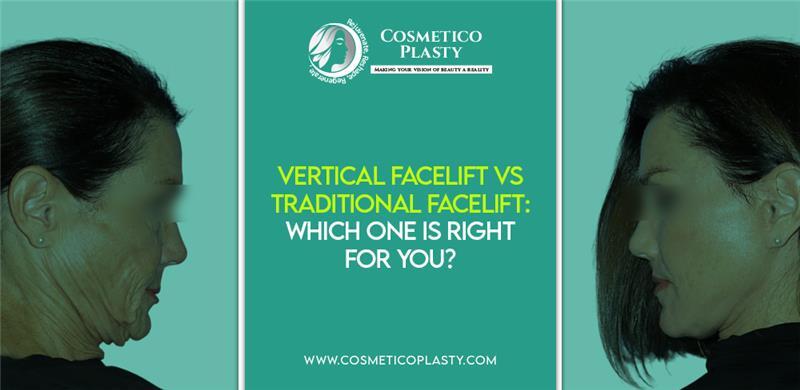
Facial aging differs among individuals. It’s based on things like genetics, lifestyle, bone structure, and skin quality. Skincare and non-surgical treatments may provide temporary improvement in appearance. Mostly cannot address time-dependent, underlying changes in the face. These include descent of tissue, muscle relaxation, and volume loss. This is where facelift surgery in Lahore is offered as a viable alternative.
In modern practice, patients will often hear two terms during consultations, i.e., vertical facelift and traditional (SMAS) facelift. Both procedures serve the same purpose of lifting and repositioning facial tissues. However, there are important distinctions among technique, recovery, and outcomes.
Having an understanding of the differences is also needed for a finish to align with your aesthetic goals, anatomy, and expectations. Professor Dr Mustehsan Bashir at Cosmeticoplasty is a known figure for providing precise, individualized facelifts along with the highest patient care standards.
In this article, there will be a thorough debate on vertical facelift vs traditional facelift, and the major considerations that can help you decide which one is right for you.
Before the discussion of the different surgical procedures, it is crucial to first understand what happens when the face shows signs of aging. To reverse aging effects with facelift surgery, it is important to recognize that the aging process leads to observable changes in the skin, fat pads, soft connective tissue, fascia, and the SMAS (superficial musculoaponeurotic system).
The common experience of the majority is
Sagging of the cheeks
Deep nasolabial folds
Jowls
Laxity of the jawline
Loss of a youthful facial shape
Banding of the neck and laxity of the tissues
Because different patients experience these changes in different areas and degrees, surgeons take different approaches to the facelift to cater to the individual and their specific aging changes.
For years, the “traditional” facelift has been looked at as the gold standard for overall rejuvenation, particularly for the lower face and neck. In recent years, the “vertical” facelift has emerged as an advancement to the traditional facelift technique that can specifically address midface descent and achieve a more natural “up” lift.
What is the vertical facelift?
A vertical facelift, also referred to as a vertical vector facelift, emphasizes relocating facial tissues upward in the natural youthful direction of the midface components. With aging, facial tissues generally sag downward and inward. The vertical facelift addresses these tissues and restores them closer to their original position.
How does it work?
The vertical facelift involves:
Small and strategically placed incisions near the ear or temporal hairline
Lifting deep tissues vertically rather than pulling skin toward the sides
Repositioning the fat pads in the cheek and midface
Most often performed in combination with SMAS or deep plane lift techniques
While tightening, no tension is placed on the surface of the skin.
What does it address?
A vertical facelift is a powerful procedure for treating:
Hanging cheeks
Laugh Lines
Early jowling
Tear trough and mid-cheek hollowing
Loss of facial volume or flattening of the midface
Because the lifting action is upward, it restores the natural heart-shaped contour of the face.
Benefits of a Vertical Facelift
It has the following advantages:
Natural-looking results: An upward lift avoids the “wind-swept” look and becomes too tight-looking, associated with overly stretched or old-fashioned facelifts.
Improved mid-facial rejuvenation: This is a great choice for patients that are primarily concerned about droopy cheeks and deep nasolabial folds around the nose and mouth.
Less tension on the skin: The results also can last longer since oftentimes the deeper tissue supports the lift and not the skin.
Suitable for younger and middle-aged patients: Ideal for patients who are in their 40s to early 60s. Moreover, those who are in earlier or moderate stages of aging are suitable candidates.
Limitations of Facelift
Less improvement for advanced neck laxity
A vertical lift concentrates only on the midface and may have to be performed with a neck lift if there is significant neck laxity.
Not all surgeons have vertical or deep-plane lifting as a focus of their practice, so expertise is very important.
Not appropriate for very heavy, thick skin
Patients who have a considerable amount of tissue laxity may require the extra lifting authority of a traditional facelift.
Traditional Facelift
For decades, the traditional facelift (SMAS facelift) has been one of the most dependable facial rejuvenation methods. This procedure tightens the SMAS layer and lifts the lower face to address advanced aging deeper in the face.
What does it involve?
A conventional facelift will usually involve:
Incisions that will run around the ears, in the hairline, and sometimes beneath the chin
Tightening and repositioning of the SMAS layer in a horizontal and slightly upward position
The removal of any excess skin
Jowl and jawline sculpting
Often, a neck lift is performed in conjunction with a facelift for overall coaction to the face.
What does it treat?
Traditional facelifts work well, improving:
Prominent jowls
Loose jawline
Deep wrinkles around the lower face
Excess skin
Sagging and banding of the neck
Benefits of a Traditional Facelift
The following are some of the benefits of a standard facelift:
Extensive lower face and neck correction: It brings a dramatic improvement to saggy skin, jowls, and aging skin on the neck.
Permanent Results: on the skin quality of the patient and lifestyle.
Better contouring: It is best if one has much laxity and higher fullness of fat volume in the patient’s face, or has old skin sagging.
Highly customizable: A facelift can be tailored to anyone wanting to add fat grafting (facial fat reduction), eyelid surgery, a brow lift, skin resurfacing, or all in one.
Disadvantages of Facelift
More invasive than a vertical facelift
Recovery time can be extended with additional swelling and bruising.
Not as effective for midface descent
While a facelift improves overall appearance, it may not lift the cheeks as naturally or effectively as a vertical facelift.
Pulling can sometimes lead to the unnatural appearance of a “pulled” facelift if not done precisely.
The horizontal pull direction can sometimes lead to an unnatural appearance when not done accurately.
A Safe, Precise and Natural-Looking Rejuvenation is Possible:
Visit Professor Dr Mustehsan Bashir at Cosmeticoplasty for Facelift Surgery
Vertical Facelift vs. Traditional Facelift: Key Differences
The table below shows clear distinctions between the two procedures.
Feature
Vertical Facelift
Traditional Facelift
Lifts face
Upward (vertical)
Horizontal with some vertical component
Appropriate for
Midface sagging, nasolabial folds, early aging
Jowls and neck laxity, thick skin laxity, major aging
Incision
Smaller, by ear and/or temple
More extensive incisions around the ear, hairline, and chin
Looks natural
Very natural appearance, youthful repositioning
Natural appearance when done well
Recovery
Short to middle recovery
Moderate to long recovery
Longevity
Long-lasting (8–12 years)
Long-lasting (10–15 years)
Effect on the neck
Limited benefit
Very good
Ideal for persons
Early 40s – 60s
50s – 70s
Procedure complexity
Moderate/high (requires specialized training)
Moderate/high – the classic "forever-done" procedure
Cost
PKR 250,000 to 600,000
PKR 250,000 to 400,000
How to Identify the Right Option?
The type of facelift that is best for you is determined by your own aging pattern, anatomy, goals and expectations. Some important factors are:
Your Major Concerns
If you have descended cheeks with deep nasolabial folds:
A vertical facelift may be your best option.
If you have a soft jawline with significant jowling or a sagging neck:
A traditional facelift typically can do more for you.
Your Age/Skin Elasticity
In their 40s and early 50s, most patients experience midface aging rather than neck aging. A vertical facelift is likely better for them.
In the late 50s, 60s or older, patients usually notice lower face and neck laxity; therefore, a traditional facelift works better.
The Extent of Aging
Mild to moderate aging: Vertical facelift
Moderate to advanced aging: Traditional facelift or a combination of both
Your Desired Look
Some patients desire just slight, natural rejuvenation through a youthful facial shape, while others desire more drastic correction.
Vertical lift – gives a subtle yet visibly youthful look.
Traditional facelift – gives a stronger sculpting and defined contour.
Surgeon's Skill
Not all surgeons are adept at vertical lift or deep-plane scarring. You want to choose a surgeon who practices a technique commensurate with your anatomy and their experience. A very qualified surgeon will direct you following the physical examination, your skin, and your goals.
Using a Combination Approach
Many Facelift surgeons are now blending techniques such as vertical lifting, tightening of the SMAS, and neck lifting into a custom hybrid technique. The outcome is:
A natural, youthful midface
Defined jawline
Smooth, tight neck
Balanced outcome without an “operated-on” appearance
Most facelift results in modern-day practice are highly individualised outcome measures, taking into account both techniques for a more complete patient outcome.
Conclusion
In the end, the availability of a range of cosmetic procedures like a facelift is no less than a blessing. At the same time, it is a reason for confusion, making the selection challenging. Vertical facelift vs. traditional facelift is an extended discussion. Both are transformative and successful procedures, and many people even consider factors like facelift surgery cost in Lahore when deciding between the two. However, the determinants for the right procedure are your unique facial anatomy and where you feel you are aging the most.
Choose a vertical facelift if you’re looking for natural midface lifting, improved aesthetics of the cheeks, and correction for nasolabial folds. However, for individuals looking for significant correction of jowls and laxity on the jawline, neck rejuvenation, and a long-lasting comprehensive result, the traditional facelift is still worthy.
The best surgery option for a patient depends on their facial structure, age and their aesthetic goals. A well-rounded surgeon like Professor Dr Mustehsan Bashir at Cosmeticoplasty can help you arrive closer to your natural look. He can provide the right guidance along with performing the procedure with high expertise and clinical judgment. Hence, being in expert hands makes the selection convenient and aligned with your objectives.
Medically Reviewed & Published By
Trusted medical content backed by academic expertise
This article has been reviewed and published by Professor Dr. Mustehsan Bashir, a renowned cosmetic and plastic surgeon with over 25 years of clinical and surgical experience.
Author of Research Methodology and Basic Biostatistics and a globally published researcher with 400+ academic citations, his work is featured on Google Scholar and leading peer-reviewed platforms.